Do you need a scoring app for badminton nights?
Paper and memory run most casual badminton nights, and they cost you the same three arguments every week. Here is what changes when the phone keeps the score.
Most badminton crews do not have a scoring problem. Two pairs walk on, somebody calls the score, the first pair to 21 walks off. The problem starts the moment they walk off: who plays next, who has sat twice, who won more tonight, and who still owes for the court. Those are the questions that eat the ten minutes between games, and paper does not answer them well.
This is the honest case for and against putting a phone in the middle of your night.
Start with what paper does well
Paper is free, it never runs out of battery, and everyone can read it. A sheet on the bench with names down the side and a tick per game is a fine record of who played. If your crew is four dads on one court every week, you do not need anything more than that. Four players, one court, no bench: there is nothing to decide.
Paper stops working at six. Six players and one court means two sit every game, and now the sheet has to answer a fairness question, not just record a result. By eight players and a second court it has to answer it twice, every few minutes, with the game already waiting.
Count the three arguments
Ask any crew that has played together for a year what they argue about. It is rarely a line call. It is these three.
Who sits. The dad who sat the first game swears he sat the third as well. Nobody wrote it down, because the game was starting. Somebody plays four in a row while somebody else plays two, and both of them notice.
Who won. Not tonight's game, which everyone remembers, but the month. A crew that plays every week has a running story, and without a record the story belongs to whoever tells it loudest.
Who paid. One dad paid the court at the desk. Six people owe him a share, two of them arrived an hour late, and he is now the crew's accountant. By the second week he has stopped asking.
None of these is about scoring. They are about memory, and memory is what a group of tired men at ten at night does not have.
See what a night looks like on paper
Eight players arrive between 7:50 and 8:20. The first four to arrive start. The next two go on when a pair loses. The last two, who were stuck in traffic, get their first game at 8:45, and the two who started have now played three. Somebody says "you two sit this one", and the two who sit are the two who complain least.
At 10:00 one dad pays 1,638 rupees at the desk and says "send me your share". Half the group sends 273. One sends 300 and tells him to keep the change. One arrived at 9 and asks if he should pay the full amount. The payer says "whatever you think is fair", which is the sentence that guarantees nobody pays the same thing twice.
Nobody knows who won the most games. Everyone has an opinion.
See what changes when the phone keeps it
The same eight players. Whoever books the night lists who paid the court while scheduling it, so the rent is known before the first game. When they arrive, one of them taps the faces on the fixture card and marks each dad In; the guide's on the night section walks through it. Four in opens the launch, and Launch live court puts two pairs on court and the rest on the bench.
Every phone in the crew sees the same score as it changes. Nobody has to call it twice. When a pair reaches the winning score, whoever holds the phone taps End round and the next four take the court.
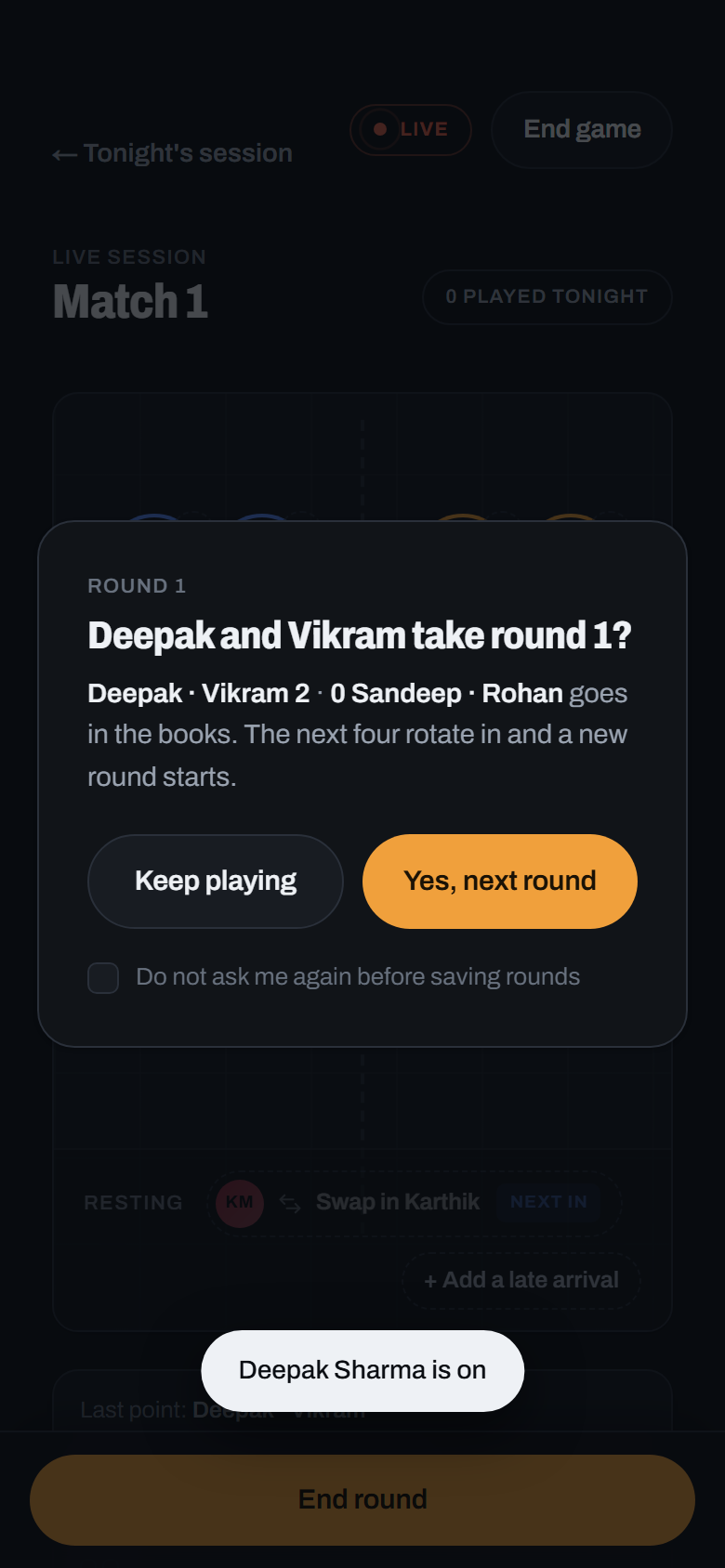
The dads in traffic walk in at 8:45. Instead of a debate, somebody taps Add a late arrival and picks them. The app seeds a late arrival level with whoever has played least, so nobody who has been there all night loses a game to him. The argument about who sits does not happen, because the count is on the screen and nobody is credited for a round he did not play.
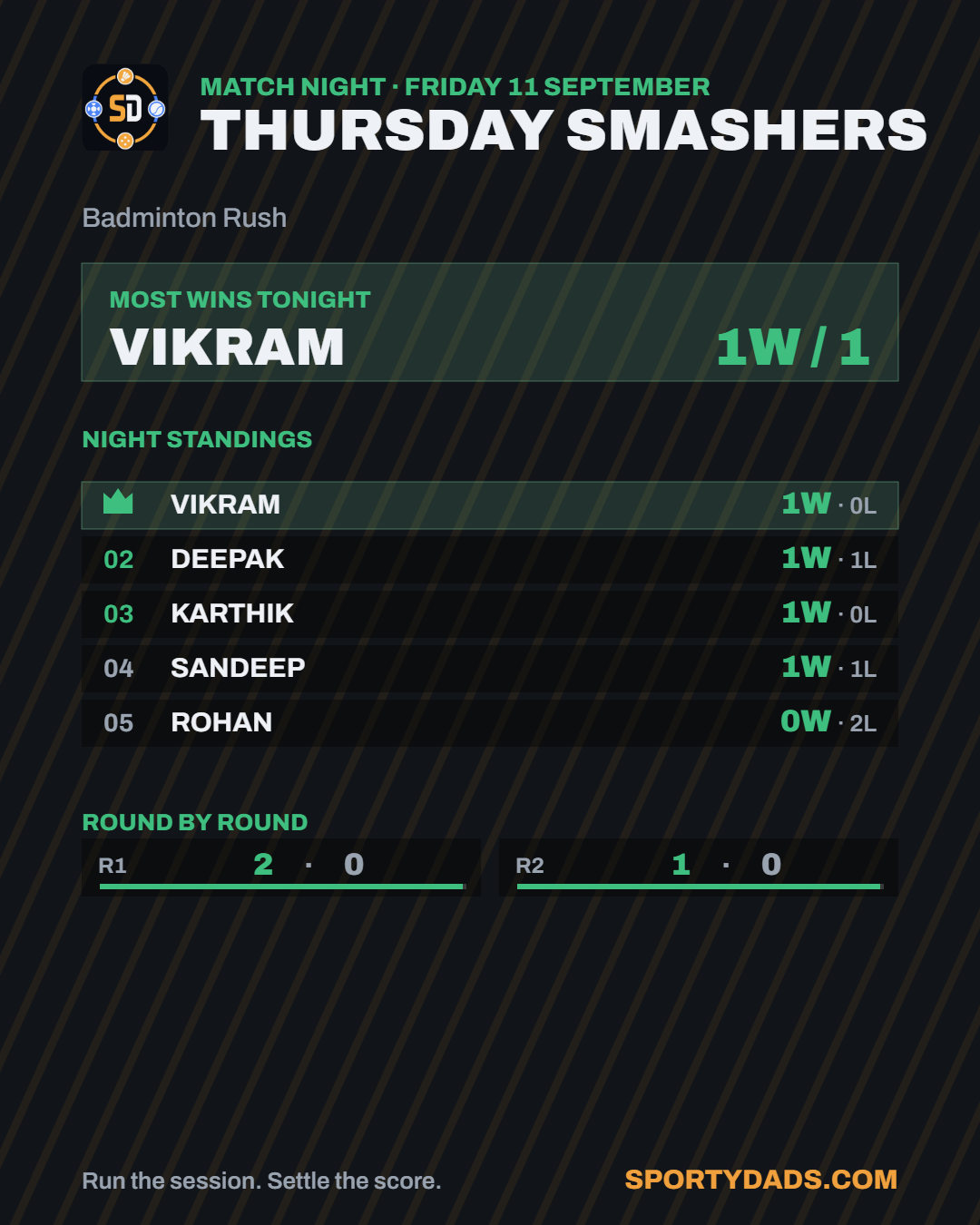
At the end of the night the page reads the standings, the rounds one by one, and the court rent split over the dads who were in, by the clock hour. Share tonight's standings sends the night's poster to the group, and the dad who paid the court is not the accountant any more: each row shows who owes him what.
Understand the rotation problem
The hard part of a badminton night is not the scoring. It is the rotation, and it is worth being precise about why.
With six players and one court, four play and two sit each game. After three games, the fairest possible outcome is that every player has sat exactly once. Reaching that by hand means remembering, after every game, who has sat and who has not, while the winners are already asking who is next. With eight players and two courts, the same question has to be answered for two benches at once, and now partner variety matters too: a crew gets bored fast when the same two pairs meet every week.
A rule that fits in one sentence is enough: the players who have played least go on next, and among them, the one who has sat longest goes first. That rule is easy to state and hard to apply at 9:30 with a shuttle in your hand. The app applies it, and the guide says what the rules on the night are: lineup changes happen between rounds, a late arrival is seeded level with whoever has played least, and once a point is on the board the controls read disabled and a tap says why. There is a longer piece on how rotation works for six to ten players.
Decide with the honest tests
You do not need a scoring app if:
- You are four players on one court and nobody ever sits.
- You play once a month and do not care who won last time.
- One dad happily pays for everyone and never asks for it back.
You probably do if:
- You are six or more with a bench, and the bench has opinions.
- The same person has been keeping the group's money straight for a year.
- The group has a running story about who is best, and it is not written down anywhere.
There is a middle path. Launch the court and use Score at end: the players on court call the score however they like, and whoever holds the phone types the final score when the round ends. The rotation, the rent split and the boards all work from that, because they read who was on court and what the round ended, not every point. The boards section of the guide explains what the points are: three for a win, one for turning up.
Know what a scoring app does not fix
An app does not make a shy player speak up, and it does not stop the dad who arrives late every week from arriving late. It does not settle a line call. It will not make eight people agree on the winning score before the first serve; that is still a conversation.
What it does is take the memory work out of the night. The fairness questions get answered by a count instead of a recollection, and the money questions get answered by a list instead of a message thread. If your nights are already easy, keep the paper. If the ten minutes between games have become the worst ten minutes of your week, the phone is cheaper than the argument.